
Google announces Nexus 4 and Nexus 10 in spite of event cancellation
Google was scheduled to announce its latest ‘pure Google’ phone, along with a larger companion to this summer’s Nexus 7 tablet, at an event in New York City today. With Hurricane Sandy and the ‘Frankenstorm’ quickly bearing down upon the East Coast, however, the event was cancelled over the weekend, with many assuming that the announcement would be delayed. I was quite disappointed by that thought (because yes, I’m that impatient for shiny new things, even when they’ve already been leaked), so imagine my surprise and delight when Google made the two devices official today anyway.
Is delight too strong a word? Probably. My anticipation for this release aside, though, these things are pretty cool.
The Nexus 4
Made by LG and based off of the company’s Optimus G, the phone runs a quad-core Qualcomm Snapdragon S4 Pro, clocked at 1.5GHz. That, along with Android 4.2 Jellybean, according to Google’s Andy Rubin, should make it the fastest phone around (and yes, 4.1 was called Jellybean too. This is apparently a ‘new flavour’ of Jellybean). Considering that it’s the fastest phone around, the starting price (for the 8GB version) of £239 sim-free is INSANE. That is unbelievably low, and I don’t know how anybody is going to compete with that; most phones with specs like this tend to start out priced around £500, so this is around HALF PRICE at LAUNCH (a 16GB version is available for £269). And that’s before we get to the 1280×768, HD, IPS, Super LCD 2 screen, 1.3mp front-facing camera and 8mp rear-facing camera, or the glass body and wireless charging capabilities. I know that what I said about the screen is totally jargon, so let me break that down for you: it’s got better resolution than an “HD Ready” (if not Full HD) TV in a 4.7″ package that will fit into your palm, has brilliant viewing angles and very natural colour reproduction. The word is that the screen is extremely close to the surface, too, so this thing should look GREAT.
Both sides of the phone are made of Gorilla Glass 2, but after seeing more cracked iPhones than you can shake a stick at over the past couple of years, only time will tell how durable a glass enclosure will be. It sure is pretty, though:
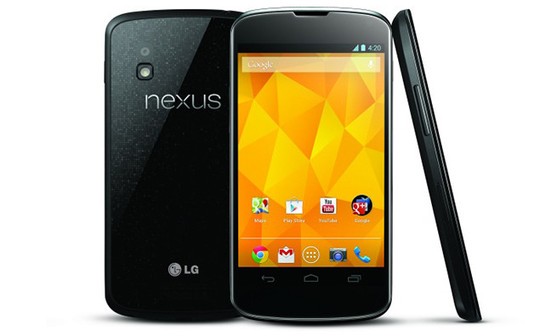
Okay, so I have some slight reservations about the pattern on the back, but apparently that produces some kind of cool holographic effect in person. Still, at £239, which is a RIDICULOUS price, you cannot afford to ignore this phone. In fact, for less than £500 you can pick up one of these AND a 16GB Nexus 7 (which just got a bump down in price to replace the outgoing 8GB version), plus have enough change to take your new gadgets out for a nice dinner, drinks and dancing. It’s £529 for the cheapest iPhone 5 (although that does have 4G LTE). If you were hoping for LTE on the Nexus 4, Google explained why it got left out. It’s not the BEST outcome, but OH MY GOD I WANT ONE (that’s what this price point has achieved. Well done, Google).
The Nexus 10
This thing is only 10 inches across, but has the same resolution as the 13-inch Retina Display on the new Macbook Pro. That’s 2,560 x 1,600 pixels. That’s 300ppi. That’s the same resolution as print media is printed in. That’s astounding.
I also feel like it’s kind of overkill. At least, I did until I realised the whole print media comparison (I used to edit, design and print a magazine while still at university). The reason that feeling was that I thought there wasn’t much point in having displays that could show more than a Full HD TV. It’s not like there’s much content available in that high a resolution, right? Well, there’s not that much video content available. But people nowadays are using tablets more and more as reading devices. I always thought that a dedicated e-reader was a better option, or even printed reading matter, but with the way that display technology is coming along, indeed, HAS NOW COME ALONG, tablets may finally be able to take over. E-readers could never really handle the rich, vibrant content of a magazine spread, whereas a tablet with the same kind of clarity as used in these magazines positions them perfectly to be how we read in the future. And that’s before we consider the multimedia that can be embedded in digital publications, too. It’s just a shame that Google hasn’t rolled out its Play Store Magazines more widely yet. Apple’s Newsstand is poised to capitalise if publishers see what I’m seeing, though.
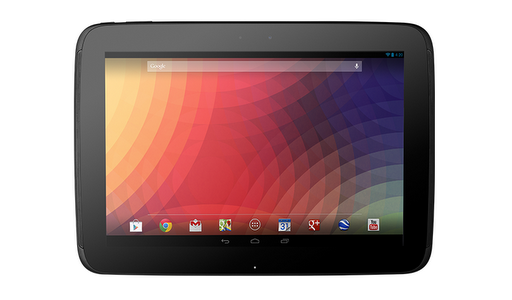
I seem to remember once hearing someone describe e-readers as a bridge device. I can’t find the quote, but this, looked at with things like Oyster, and it appears that whoever said that was probably right. Welcome to the future. Maybe.
The Nexus 10 starts at £329. The Nexus 4, 7 and 10 can all be purchased from the Google Play Store, here.

 AlphaQuirky